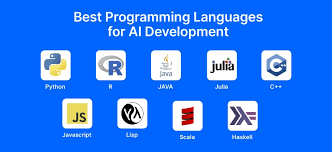
Artificial Intelligence (AI) has become one of the fastest-growing fields in technology. Choosing the right programming language is crucial for developing AI applications efficiently. While there are many languages available, a few stand out due to their libraries, frameworks, and ease of integration for AI tasks.
1. Python
Python is the most popular language for AI development due to its simplicity, readability, and extensive libraries. Libraries such as TensorFlow, Keras, PyTorch, and scikit-learn make it easy to build machine learning, deep learning, and data analysis applications. Python’s large community also provides robust support, tutorials, and pre-built models, reducing development time significantly.
2. R
R is a language designed for statistical computing and data visualization, making it ideal for AI applications that require heavy data analysis. Packages such as caret, nnet, and randomForest are commonly used in predictive modeling, classification, and clustering. R is widely used in research and academic AI projects due to its powerful statistical capabilities.
3. Java
Java is known for its platform independence, scalability, and speed. Libraries such as Deeplearning4j and Weka support AI development, particularly for large-scale enterprise applications. Java’s strong object-oriented structure also allows developers to build complex AI systems with reusable and maintainable code.
4. C++
C++ is highly efficient and fast, which is crucial for AI systems requiring real-time processing or complex algorithms. It is commonly used in AI fields like robotics, game development, and simulation, where performance matters. However, C++ has a steeper learning curve compared to Python, and fewer high-level AI libraries are available.
5. JavaScript
JavaScript is gaining popularity in AI development due to libraries such as TensorFlow.js and Brain.js. JavaScript allows AI models to run directly in the browser, enabling interactive AI-powered web applications without server-side computation. This is especially useful for AI-driven UI, real-time visualization, and client-side applications.
6. Julia
Julia is designed for high-performance numerical computing. It combines the speed of C++ with the simplicity of Python, making it suitable for machine learning, deep learning, and scientific computing. Its growing ecosystem, including libraries like Flux.jl and MLJ.jl, makes Julia a promising language for AI researchers.
7. Prolog and LISP
While less commonly used today, Prolog and LISP are historically significant in AI development. LISP excels in symbolic computation and was widely used in early AI research, while Prolog is effective for logical reasoning and rule-based systems. These languages are still valuable for certain academic and specialized AI applications.
Conclusion
The choice of programming language for AI depends on the project requirements, team expertise, and available libraries. Python remains the most versatile and beginner-friendly option, while R excels in statistics, Java and C++ in performance, and JavaScript in web integration. Emerging languages like Julia offer high-performance alternatives, while Prolog and LISP are suited for specialized tasks. Selecting the right language ensures faster development, better performance, and scalable AI solutions.
References
1. Best Programming Languages for AI, Medium (link)
2. Top Programming Languages for AI Development, Simplilearn (link)
3. The Best Programming Languages for AI, FreeCodeCamp (link)